An End to a Means: Interaction-First Lesson Planning For Adult Language Learners
Guest post written by Rob Sheppard, First Literacy Workshop Presenter & Founder of Ginseng English
 Let’s start with my hot take: backward planning ain’t all it’s cracked up to be, at least not when it comes to language classrooms for adult learners. It makes superficial intuitive sense: you think about where you want students to be at the end of the week/semester/unit/whatever and plan step-by-step what will get them where you want them to get. But sadly, I just don’t think it actually works that neatly. I don’t think students all start from the same place. I don’t think they progress at the same rate, or that their progress can be predicted. I don’t think we can know exactly what it is they’re going to have learned by the end of the day, the week, the unit. And, I think the more we recognize this and reckon with that uncertainty, the better off we and our teaching will be. There’s lots more that could be said about this, caveats and exceptions, but I don’t want to get hung up on the details because my hot take was just a hook to get you, Reader, to ask the question:
If we don’t plan backward from our objectives, how do we plan? What do we plan?
My answer: interaction. At the center of my classroom planning is always the interaction that I want to unfold between learners, and I believe the primary task of the language teacher is to plan and orchestrate high-quality, meaning-focused interactions from which learning will emerge. I tend to think of language lessons as cycles of engagement, interaction, and reinforcement. And this is what guides my lesson planning.
From Present-Practice-Produce to Think-Pair-Share
An assumption underlying this approach is that language develops primarily from use. Part and parcel of this assumption is that language does not develop primarily from learning and applying rules.
This distinction is exemplified by two approaches to planning lessons: If learning were about internalizing, then applying, then automating rules about language, then present-practice-produce (P.P.P) would be a great way to structure a lesson. But since the dominant theories posit that language develops through use, a preferable sequence is think-pair-share: students individually think about their own response to a prompt, then pair and discuss with a neighbor, and then share (about themselves or their partner) with the entire class, resulting in a large quantity and range of meaningful interactions.
The rest of this post will discuss flexible activity types that I use because I find that they are rich in meaningful interaction. I’m going to focus on three broad groupings of activity types: sorting and ordering, jigsaw and info gap, and collaborative writing activities.
Sorting and Ordering Activities
Sorting and ordering activities are precisely what they sound like. Students are placed into small groups and tasked with organizing sets of people, things, ideas. It could be ordering foods by how healthy they are, ranking rappers by who is the greatest of all time, prioritizing monthly expenses by due date and size of the bill. It could be sorting local politicians or travel destinations or famous paintings into categories of their own selection or provided by you.
Here’s a version that I do in which students place household chemicals on a 2-axis chart indicating both how useful and how dangerous they are: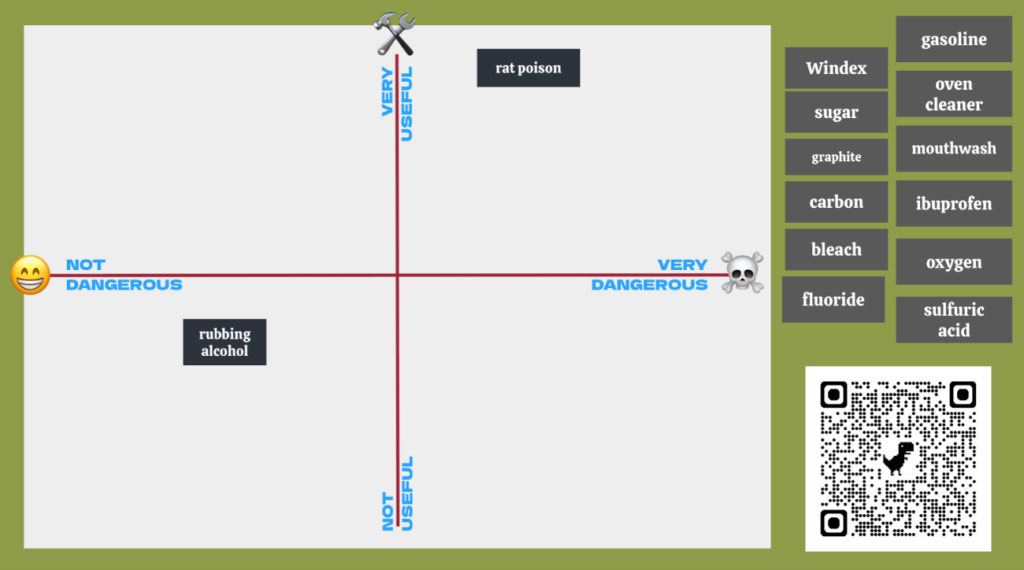
Here’s another in which they sort foods by which meal they can be eaten during. Cultural differences make this a source of vigorous debate!
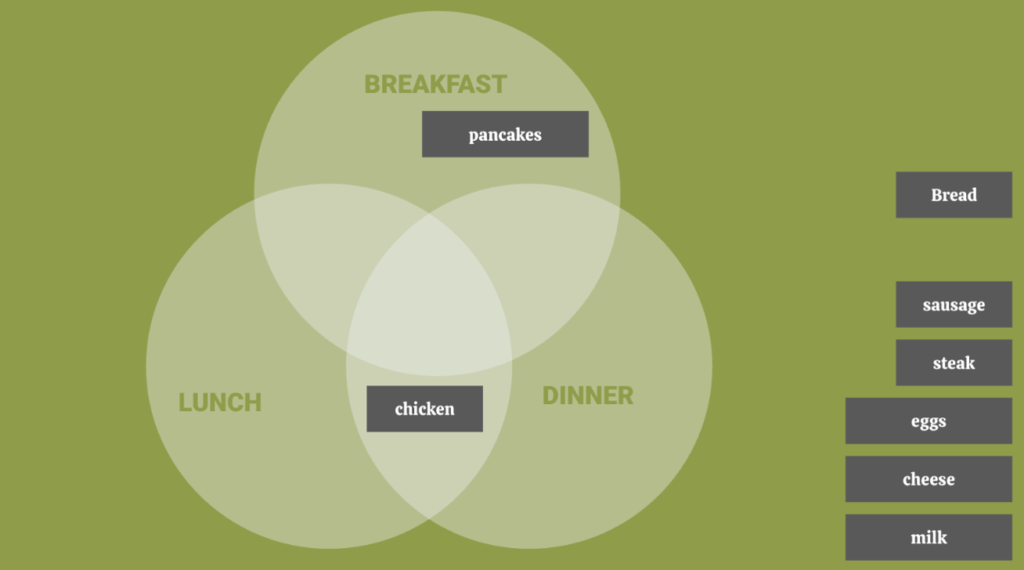
In sorting and organizing activities, the language use is driven by the need to make group decisions that are subjective or up to debate. The task can only be completed with a great deal of negotiation. My preference is for subjective judgments and types of organization that are more authentic than contrived. I also like to do this kind of activity with manipulable elements: words on cards or realia that can be physically placed on a graphic organizer. You can provide students with the list of things to sort, but it can be even more engaging and effective if you start by sourcing the list directly from them.
The task, of course, is not about the outcome. It’s not about arriving at a “right” answer; the task exists to draw students into a highly engaging, meaning-focused interaction. Our adult learners, in the thick of the task, will be focused on its completion. The language feels like merely a means to that end. But as teachers, what we are doing is designing an end to motivate that means.
Jigsaws and Information Gaps
In jigsaws and information gaps, the language use is propelled by the fact that students only have partial information and need to talk to their classmates in order to assemble the full picture.
The two activities achieve this in different ways. A common form of jigsaw involves the teacher taking a longer text, chopping it up by paragraph or by section, and distributing the different segments to different groups of students. The instructions to students might be to read their section carefully, becoming “experts” on the contents, perhaps extract 3 key bullet points, and then, when the class comes back together, be prepared to teach their classmates and reconstruct the whole text.
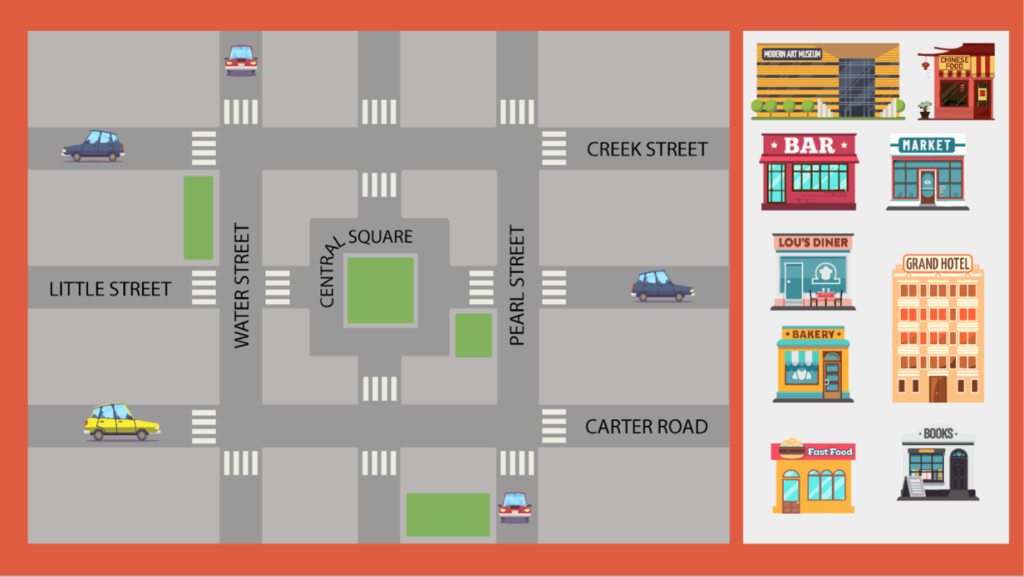
There is a similar principle at work in information gaps, but the setup is different. Rather than a divided text, one student might have a complete city map and their partner might have a version with the buildings missing, and the task is to fill in the map by using only speech. Or each student can have a map with half of the buildings and their partner has the complementary information. Another variation draws on those old spot-the-difference puzzles where you’ve got to compare two nearly identical images and find small differences, except each partner has only one of the images, and the differences are discovered not through visual comparison but by talking in detail about the picture they have in front of them until they discover where their images diverge.
Here’s an example of a blank map with buildings that students need to add as they discuss with their partner, who has the completed map.
Sorting and ordering activities, jigsaws, and info gaps are all associated with task-based language teaching (TBLT), an approach in which instruction is built around meaningful communicative tasks rather than grammar or vocabulary forms.
Joint Construction
I’m not going to do this one justice with limited space, but I want to at least gesture in the right direction, because joint construction is a category of activity that can be really transformative for the language classroom.
Joint construction basically means writing a text together as a class. In an academic English class, it can be a great way to teach writing, because students need to discuss and negotiate the sorts of choices that writers often make internally, invisibly. But there’s a form of joint construction that isn’t actually about teaching the specific subskill of writing. The language experience approach (LEA) is a broad, flexible approach to language teaching that has joint construction at its core, but that develops the whole language.
You’ll find different accounts of the stages of LEA, but to me there are two essential elements: an experience shared by the whole class and an account of that experience jointly constructed by the whole class. First, you arrange for the group of students to have a shared experience: a trip to the hardware store, a game that they played together, or even just a movie that you all watched. What matters is that the experience is shared, because this experience provides the material that the group will then, together, write about. Then you guide students through the process of writing about that experience on the board. The first couple of times you do this, you’ll need to scaffold the writing a good deal. But as they get the hang of it, you’ll want to take a more passive role, serving primarily as scribe. The language that students produce in that retelling becomes the basis of your language lesson. What grammar are they on the cusp of using? What vocabulary would be helpful to better capture the experience? The fact that the lesson begins with a shared experience and a class-generated text means that your language lesson is grounded in meaningful communication. It starts with the students rather than a list of vocabulary and grammar items selected by a publisher in a textbook.
Closing
Each of these activities is sort of an anchor activity, but not a lesson unto itself. As I said earlier, my three-word approach to conceptualizing language lessons is engagement, interaction, and reinforcement. In the leadup to these bigger interactive anchors, I use a number of simple activities the intent of which is generally to capture attention and draw out learners’ existing knowledge and experience related to the topic. And then after the main activity, my preferred follow-ups involve lots of repetition, often in the form of fluency-building activities, and also some kind of individual recounting of the group activity, so that students can make personal sense of the shared activity in their own language.
For the most part, I don’t think that we can plan the particular linguistic development that will happen over a given curricular unit. Our learners are too diverse, and the mechanics of language development are too complex, and the role of the unpredictable and the uncontrollable in the classroom is significant. But I do believe that planning for high-quality, meaningful interactions will ensure that each student is making progress along their own individual trajectory.